Basic Sentence Patterns in English: Basic 5 and Basic 7 Explained
Learn the basic 5 and basic 7 English sentence patterns with examples, differences, derived structures, and practice exercises.
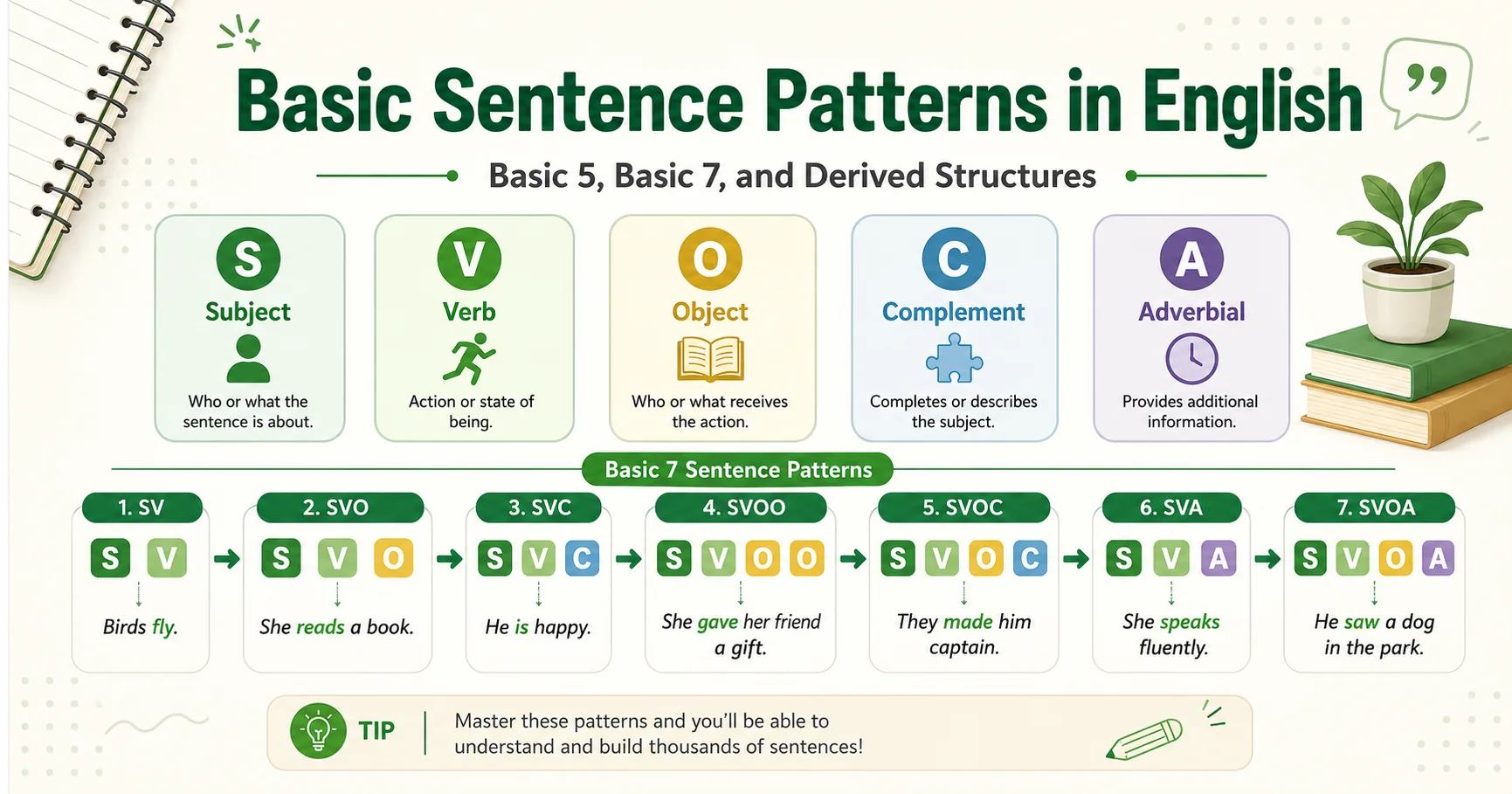
English sentences may look difficult when they become long, but most of them are built from a few basic patterns. Once you understand these patterns, you can understand, write, and analyze sentences much more confidently.
For example, look at these sentences:
- Birds fly.
- She opened the door.
- He is a teacher.
- They made him captain.
- She lives in Delhi.
- He put the book on the table.
These sentences are different in length and meaning, but each one follows a clear structure. That structure is called a sentence pattern.
Many grammar books teach 5 basic sentence patterns. Some books teach 7 basic sentence patterns. This difference often confuses learners.
One book may say:
English has five basic sentence patterns.
Another book may say:
English has seven basic sentence patterns.
Both approaches can be useful. The difference mainly comes from how the book treats adverbials, especially adverbials that are necessary to complete the meaning of a sentence.
This post explains everything step by step:
- What sentence patterns are
- What S, V, O, C, and A mean
- The basic 5 sentence patterns
- The basic 7 sentence patterns
- The difference between basic 5 and basic 7
- Optional and obligatory adverbials
- Derived structures such as negatives, questions, passive voice, complex sentences, relative clauses, and more
- How to analyze long sentences without confusion
By the end, you should be able to look at most English sentences and understand their basic structure.
A sentence pattern is the basic arrangement of the main elements in a sentence or clause.
In simple words, it shows how the important parts of a sentence are placed.
For example:
| Sentence | Pattern |
|---|---|
| Birds fly. | Subject + Verb |
| She read a book. | Subject + Verb + Object |
| He is happy. | Subject + Verb + Complement |
| My father gave me a gift. | Subject + Verb + Indirect Object + Direct Object |
A sentence pattern does not include every small word in the sentence. It focuses on the core structure.
Look at this sentence:
The little boy in the red shirt quickly opened the wooden door.
This sentence has many words, but the core is:
boy opened door
So the basic pattern is:
Subject + Verb + Object
That is:
SVO
Understanding this helps you reduce long sentences into simple structures.
Before studying patterns, we should understand four important terms.
A sentence is a group of words that expresses a complete thought.
Examples:
- She smiled.
- He bought a car.
- Although it was raining, we went outside.
A sentence begins with a capital letter and usually ends with a full stop, question mark, or exclamation mark.
A clause is a group of words that has a subject and a verb.
Examples:
- she smiled
- he bought a car
- it was raining
A sentence may contain one clause or more than one clause.
Example:
She stayed home because it was raining.
This sentence has two clauses:
- She stayed home.
- because it was raining.
A phrase is a group of words that works as one unit but does not have both a subject and a finite verb.
Examples:
- in the morning
- the tall boy
- very beautiful
- to learn English
- reading books
A phrase can be part of a sentence, but it is not usually a complete sentence by itself.
A sentence pattern is the arrangement of the essential elements of a clause.
For example:
She wrote a letter.
Essential elements:
- She = Subject
- wrote = Verb
- a letter = Object
Pattern:
SVO
Most sentence pattern analysis is really clause pattern analysis, because a long sentence may contain more than one clause.
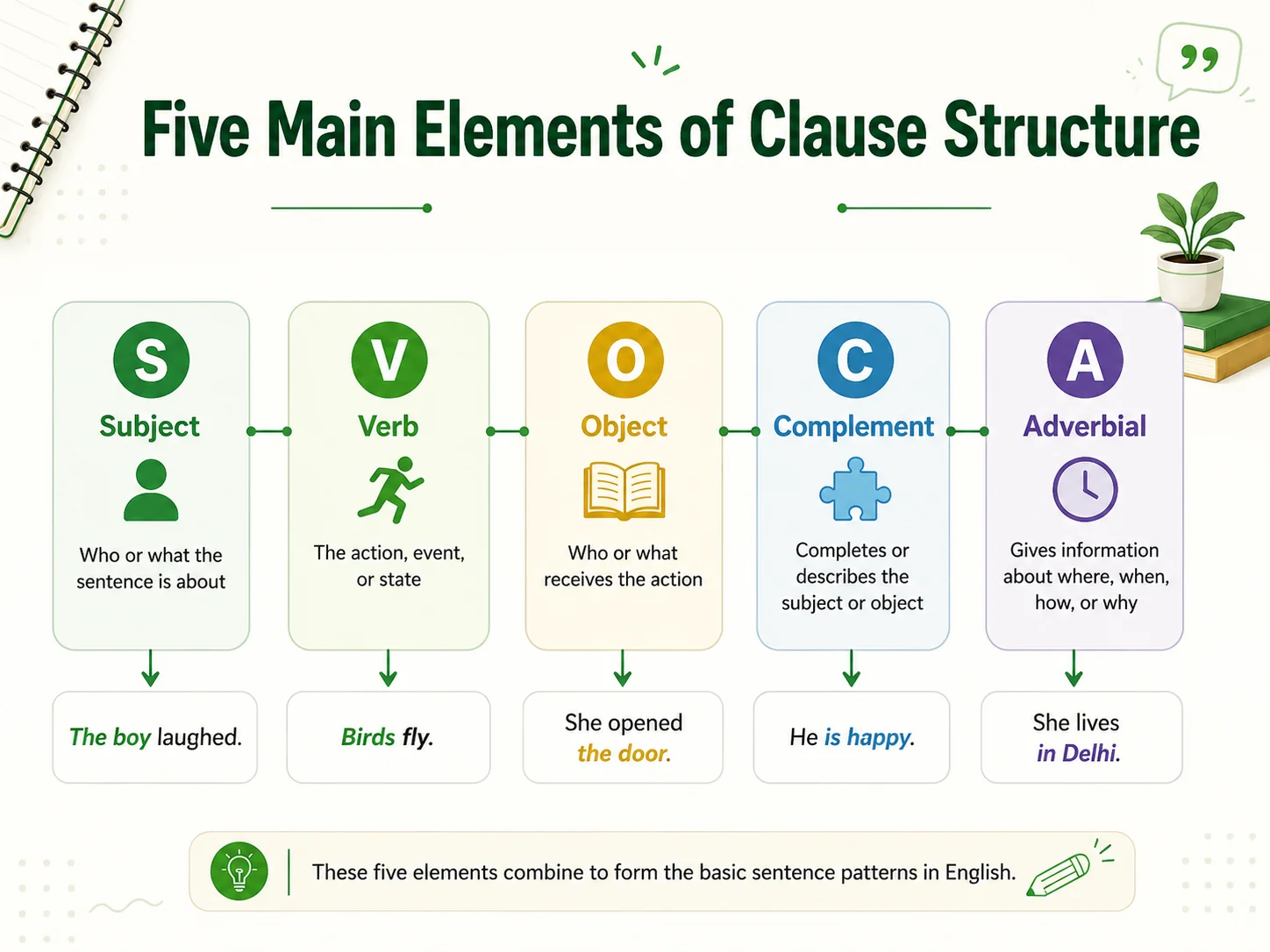
Most basic sentence patterns are built from five main elements:
| Symbol | Full Form |
|---|---|
| S | Subject |
| V | Verb |
| O | Object |
| C | Complement |
| A | Adverbial |
These five elements are the building blocks of sentence patterns.
The subject is the person, thing, place, idea, or activity that the sentence is mainly about.
Examples:
The child laughed.
Subject: The child
My brother is a doctor.
Subject: My brother
The book seems interesting.
Subject: The book
The subject often performs the action, but not always.
In this sentence:
The boy kicked the ball.
The subject the boy performs the action.
But in this sentence:
The boy is tired.
The subject the boy is not performing an action. He is being described.
So, the subject can:
- Do an action
- Be in a state
- Be described
- Be identified
- Experience something
A subject can be:
Birds fly.
Subject: Birds
She smiled.
Subject: She
The tall man near the gate waved.
Subject: The tall man near the gate
Swimming every morning is healthy.
Subject: Swimming every morning
To forgive others is difficult.
Subject: To forgive others
What he said surprised everyone.
Subject: What he said
So, the subject is not always one word. It can be a long group of words.
The verb is the most important part of the sentence pattern. It tells us what the subject does, what happens, or what state the subject is in.
Examples:
Birds fly.
Verb: fly
She opened the window.
Verb: opened
He is honest.
Verb: is
The verb often decides what other elements are needed in the sentence.
For example:
She slept.
The verb slept does not need an object.
But:
She opened.
This feels incomplete in normal use. We want to know:
She opened what?
So we say:
She opened the door.
That means the verb open usually needs an object.
To understand sentence patterns, you need to understand verb types.
An intransitive verb does not need an object.
Examples:
- sleep
- arrive
- laugh
- cry
- die
- disappear
Sentence:
The baby slept.
Pattern:
SV
A transitive verb needs an object.
Examples:
- read
- write
- open
- close
- build
- buy
- watch
Sentence:
She read a book.
Pattern:
SVO
A linking verb connects the subject to a word that describes or identifies it.
Examples:
- be
- become
- seem
- appear
- look
- feel
- smell
- taste
- sound
Sentence:
He is happy.
Pattern:
SVC
Here, happy describes he.
A ditransitive verb takes two objects:
- Indirect object
- Direct object
Examples:
- give
- send
- tell
- show
- offer
- lend
- teach
- buy
Sentence:
She gave me a book.
Pattern:
SVOO
Here:
- me = indirect object
- a book = direct object
A complex transitive verb takes an object and an object complement.
Examples:
- make
- call
- name
- elect
- consider
- find
- keep
Sentence:
They made him captain.
Pattern:
SVOC
Here:
- him = object
- captain = object complement
The word captain completes the meaning by telling us what him became.
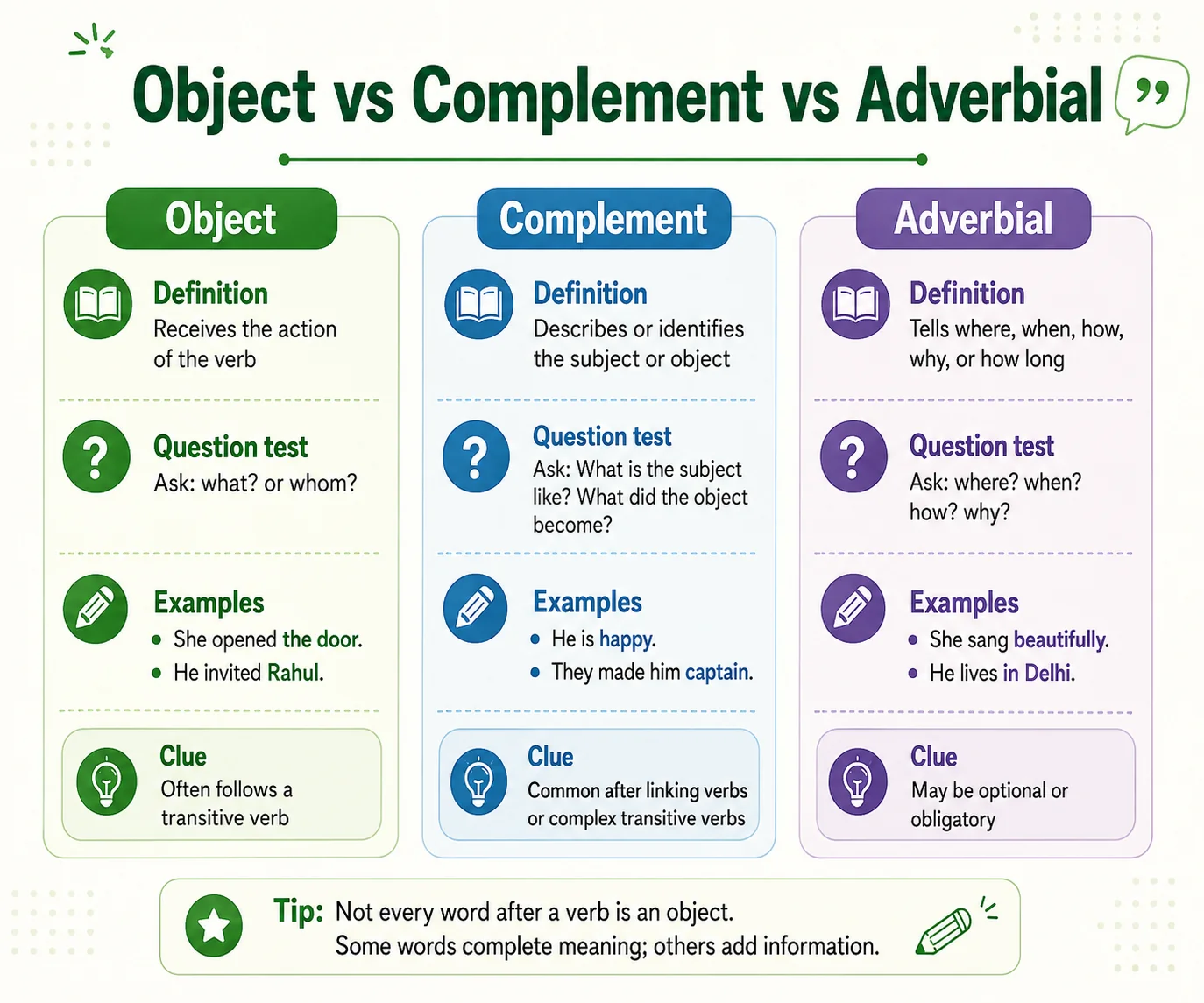
An object is the person or thing that receives the action of the verb.
Example:
She wrote a letter.
Ask:
She wrote what?
Answer:
a letter
So, a letter is the object.
Another example:
He helped me.
Ask:
He helped whom?
Answer:
me
So, me is the object.
A direct object directly receives the action.
Examples:
She bought a dress.
Direct object: a dress
They built a house.
Direct object: a house
I watched the movie.
Direct object: the movie
An indirect object tells us the receiver or beneficiary of the direct object.
Example:
He gave me a pen.
Here:
- me = indirect object
- a pen = direct object
The pen is the thing given.
Me is the person who receives it.
Another example:
She told us a story.
Here:
- us = indirect object
- a story = direct object
To find the object, ask:
- Verb + what?
- Verb + whom?
Examples:
She opened the door.
Opened what?
the door
So, the door is the object.
He invited Rahul.
Invited whom?
Rahul
So, Rahul is the object.
Many direct objects can become the subject in passive voice.
Active:
She opened the door.
Passive:
The door was opened by her.
Because the door can become the subject of the passive sentence, it is a direct object in the active sentence.
But be careful: the passive test does not work with every verb in the same way, and not every object is naturally used in passive voice. Still, it is a useful test for many basic sentences.
A complement completes the meaning of the subject or object.
The word complement means something that completes.
There are two important types:
- Subject complement
- Object complement
A subject complement describes or identifies the subject.
It usually comes after a linking verb.
Examples:
She is happy.
Subject: She
Verb: is
Subject complement: happy
The word happy describes the subject she.
Another example:
He became a doctor.
Subject: He
Verb: became
Subject complement: a doctor
The phrase a doctor identifies what he became.
The soup smells delicious.
Subject complement: delicious
The sky looks blue.
Subject complement: blue
My sister is a lawyer.
Subject complement: a lawyer
This is my favorite book.
Subject complement: my favorite book
She is in trouble.
Subject complement: in trouble
Some grammars may call this a complement; others may analyze it as an adverbial depending on the structure and meaning. Grammar analysis can vary, but the important point is that the phrase is necessary to complete the meaning.
An object complement describes or identifies the object.
Example:
They made him captain.
Subject: They
Verb: made
Object: him
Object complement: captain
The word captain tells us what him became.
Another example:
We found the room empty.
Subject: We
Verb: found
Object: the room
Object complement: empty
The word empty describes the room.
They elected her president.
Object: her
Object complement: president
The news made him sad.
Object: him
Object complement: sad
Keep your hands off the table.
Object: your hands
Object complement or required phrase: off the table
Different grammar books may analyze some of these structures differently, but the basic idea is that the element after the object completes the meaning.
Many learners confuse object and complement because both can come after the verb.
Compare these two sentences:
She met a doctor.
Pattern:
SVO
Here, a doctor is an object. She met someone.
Now compare:
She became a doctor.
Pattern:
SVC
Here, a doctor is a complement. It identifies the subject she.
The difference is meaning.
In She met a doctor, the doctor is a different person.
In She became a doctor, she and the doctor are the same person.
More examples:
| Sentence | Pattern | Explanation |
|---|---|---|
| He found a key. | SVO | A key is the thing found. |
| He found the question difficult. | SVOC | Difficult describes the question. |
| She made tea. | SVO | Tea is the thing made. |
| She made him angry. | SVOC | Angry describes him. |
| He is a teacher. | SVC | A teacher identifies he. |
| He hired a teacher. | SVO | A teacher is the person hired. |
A simple test:
If the word after the verb receives the action, it is usually an object.
If the word after the verb describes or identifies the subject or object, it is usually a complement.
An adverbial gives extra or necessary information about the action, event, or situation.
Adverbials often answer questions like:
- Where?
- When?
- How?
- Why?
- How long?
- How often?
- To what extent?
Examples:
She sang beautifully.
Adverbial: beautifully
Question: How did she sing?
We met yesterday.
Adverbial: yesterday
Question: When did we meet?
He lives in Mumbai.
Adverbial: in Mumbai
Question: Where does he live?
An adverbial can be:
She spoke softly.
Adverbial: softly
He sat on the chair.
Adverbial: on the chair
She left last night.
Adverbial: last night
She cried because she was hurt.
Adverbial clause: because she was hurt
This is one of the most important points in understanding the difference between the basic 5 and the basic 7 sentence patterns.
An optional adverbial can be removed, and the sentence still remains complete.
Example:
She sang beautifully.
Remove the adverbial:
She sang.
The sentence is still complete.
So, beautifully is optional.
Another example:
They played cricket in the park.
Remove the adverbial:
They played cricket.
Still complete.
So, in the park is optional.
An obligatory adverbial is needed to complete the meaning of the verb.
Example:
She lives in Delhi.
If we remove in Delhi, we get:
She lives.
This can be grammatical in a special context, for example meaning “She is alive.” But in ordinary use, when we use live to mean “reside,” we normally need a place.
So:
She lives in Delhi.
is better analyzed as:
SVA
Another example:
He put the book on the table.
Remove the adverbial:
He put the book.
This is incomplete. We want to ask:
He put the book where?
So, on the table is obligatory.
Pattern:
SVOA
Remove the adverbial and ask:
- Is the sentence still complete?
- Is the meaning still natural?
- Does the verb need that information?
If the sentence remains complete, the adverbial is optional.
If the sentence becomes incomplete, unclear, or unnatural, the adverbial is obligatory.
Examples:
| Sentence | Remove Adverbial | Result | Type |
|---|---|---|---|
| She smiled happily. | She smiled. | Complete | Optional |
| He slept on the sofa. | He slept. | Complete | Optional |
| She lives in Pune. | She lives. | Incomplete or different meaning in normal context | Obligatory |
| He put the keys on the shelf. | He put the keys. | Incomplete | Obligatory |
| The meeting lasted for two hours. | The meeting lasted. | Incomplete in ordinary use | Obligatory |
Many traditional grammar books teach five basic sentence patterns. These are:
- SV
- SVO
- SVC
- SVOO
- SVOC
This model focuses on four main elements:
- Subject
- Verb
- Object
- Complement
Adverbials are often treated as extra information added to the basic pattern.
For example:
She slept peacefully.
In the basic 5 model, this may be analyzed as:
SV + optional adverbial
Core pattern:
She slept.
Pattern:
SV
Another example:
She wrote a letter yesterday.
Core sentence:
She wrote a letter.
Pattern:
SVO
The word yesterday is extra time information.
So the basic 5 model is simple and useful for beginners.
However, it may not clearly explain sentences like:
She lives in Kolkata.
or:
He put the phone on the desk.
In these sentences, the adverbial is not just extra. It is needed to complete the structure. That is why some books teach the basic 7.
The basic 5 sentence patterns are:
| No. | Pattern | Full Form |
|---|---|---|
| 1 | SV | Subject + Verb |
| 2 | SVO | Subject + Verb + Object |
| 3 | SVC | Subject + Verb + Complement |
| 4 | SVOO | Subject + Verb + Indirect Object + Direct Object |
| 5 | SVOC | Subject + Verb + Object + Object Complement |
Let us study each one carefully.
The first basic pattern is:
Subject + Verb
This pattern uses an intransitive verb. The verb does not need an object.
Examples:
Birds fly.
Subject: Birds
Verb: fly
Pattern: SV
The baby cried.
Subject: The baby
Verb: cried
Pattern: SV
The sun rose.
Subject: The sun
Verb: rose
Pattern: SV
My phone rang.
Subject: My phone
Verb: rang
Pattern: SV
- The dog barked.
- The children laughed.
- The train arrived.
- The old man slept.
- The stars disappeared.
- The flowers bloomed.
You can add adverbials to SV sentences.
The baby cried loudly.
Core:
The baby cried.
Pattern:
SV
Adverbial:
loudly
Another example:
The train arrived late.
Core:
The train arrived.
Pattern:
SV
Adverbial:
late
The adverbial gives more information, but the sentence is complete without it.
Some learners think every verb needs an object. This is not true.
Incorrect thinking:
The baby cried something.
Correct:
The baby cried.
The verb cry is intransitive in this use.
The second basic pattern is:
Subject + Verb + Object
This pattern uses a transitive verb. The verb needs an object to complete its meaning.
Examples:
She read a book.
Subject: She
Verb: read
Object: a book
Pattern: SVO
They built a house.
Subject: They
Verb: built
Object: a house
Pattern: SVO
We watched the match.
Subject: We
Verb: watched
Object: the match
Pattern: SVO
- He opened the door.
- She closed the window.
- I bought a pen.
- They painted the wall.
- We enjoyed the movie.
- The teacher explained the lesson.
Ask:
Verb + what?
or:
Verb + whom?
Example:
She opened the window.
Opened what?
the window
So, the window is the object.
Example:
He invited Rohan.
Invited whom?
Rohan
So, Rohan is the object.
Many SVO sentences can become passive.
Active:
She opened the window.
Passive:
The window was opened by her.
Active:
They built a house.
Passive:
A house was built by them.
This shows that the window and a house are objects in the active sentences.
Adverbials can be added:
She read a book yesterday.
Core:
She read a book.
Pattern:
SVO
Adverbial:
yesterday
Another example:
They built a house near the river.
Core:
They built a house.
Pattern:
SVO
Adverbial:
near the river
Do not confuse an adverbial with an object.
Example:
She went to school.
Some learners may say to school is an object. But it is not a direct object. It tells direction or place.
Depending on the grammar system, this may be analyzed as:
SVA
because to school is an adverbial of direction.
The third basic pattern is:
Subject + Verb + Subject Complement
This pattern usually uses a linking verb.
The complement describes or identifies the subject.
Examples:
He is honest.
Subject: He
Verb: is
Complement: honest
Pattern: SVC
She became a teacher.
Subject: She
Verb: became
Complement: a teacher
Pattern: SVC
The soup smells delicious.
Subject: The soup
Verb: smells
Complement: delicious
Pattern: SVC
- be
- become
- seem
- appear
- look
- feel
- smell
- taste
- sound
- remain
- grow
- turn
- get
Examples:
The sky looks cloudy.
Pattern:
SVC
The milk turned sour.
Pattern:
SVC
He remained silent.
Pattern:
SVC
She is tired.
Tired describes she.
The flowers smell fresh.
Fresh describes the flowers.
My uncle is a doctor.
A doctor identifies my uncle.
This is my house.
My house identifies this.
Compare:
She made tea.
Pattern:
SVO
Here, tea is the object. Tea receives the action of making.
Now compare:
She became tired.
Pattern:
SVC
Here, tired is not an object. It describes the subject she.
More comparisons:
| SVO | SVC |
|---|---|
| He met a teacher. | He became a teacher. |
| She touched the flower. | The flower feels soft. |
| I tasted the soup. | The soup tastes salty. |
| They painted the wall. | The wall looks beautiful. |
Incorrect:
He is a teacher.
“A teacher” is an object.
Correct:
He is a teacher.
“A teacher” is a subject complement.
Why?
Because he and a teacher refer to the same person.
The fourth basic pattern is:
Subject + Verb + Indirect Object + Direct Object
This pattern uses a ditransitive verb.
A ditransitive verb takes two objects:
- Indirect object
- Direct object
Example:
He gave me a pen.
Subject: He
Verb: gave
Indirect object: me
Direct object: a pen
Pattern: SVOO
The direct object is the thing given.
The indirect object is the receiver.
She told us a story.
Subject: She
Verb: told
Indirect object: us
Direct object: a story
My father bought me a laptop.
Subject: My father
Verb: bought
Indirect object: me
Direct object: a laptop
The teacher taught the students grammar.
Subject: The teacher
Verb: taught
Indirect object: the students
Direct object: grammar
He sent his friend a message.
Subject: He
Verb: sent
Indirect object: his friend
Direct object: a message
- give
- send
- tell
- show
- offer
- lend
- teach
- buy
- bring
- make
- write
- promise
- hand
Many SVOO sentences can be rewritten with to or for.
Example:
He gave me a pen.
Can become:
He gave a pen to me.
Another example:
She bought me a dress.
Can become:
She bought a dress for me.
Use to when something is transferred to someone.
Examples:
- give a book to me
- send a message to him
- show the answer to us
- tell the story to them
Use for when something is done for someone’s benefit.
Examples:
- buy a gift for me
- make tea for her
- cook dinner for them
Some learners confuse the indirect object and direct object.
In this sentence:
He gave me a pen.
Incorrect:
me = direct object
a pen = indirect object
Correct:
me = indirect object
a pen = direct object
Ask:
What did he give?
a pen
So, a pen is the direct object.
To whom did he give it?
me
So, me is the indirect object.
The fifth basic pattern is:
Subject + Verb + Object + Object Complement
The object complement describes or identifies the object.
Example:
They made him captain.
Subject: They
Verb: made
Object: him
Object complement: captain
Pattern: SVOC
The word captain tells us what him became.
We found the room empty.
Object: the room
Object complement: empty
The news made her sad.
Object: her
Object complement: sad
They elected him president.
Object: him
Object complement: president
She painted the wall blue.
Object: the wall
Object complement: blue
We considered the plan risky.
Object: the plan
Object complement: risky
- make
- find
- call
- name
- elect
- consider
- keep
- paint
- leave
- appoint
- think
- believe
In SVOC, the object and the object complement are closely connected.
Example:
They made him captain.
him = captain
We found the room empty.
room = empty
She painted the wall blue.
wall = blue
The complement says something about the object.
This is a major confusion point.
Compare:
He gave me a pen.
Pattern:
SVOO
Here:
- me = receiver
- a pen = thing received
Now compare:
They made him captain.
Pattern:
SVOC
Here:
- him = object
- captain = what he became
In SVOO, there are two objects.
In SVOC, there is one object and one complement.
More examples:
| Sentence | Pattern | Explanation |
|---|---|---|
| She sent him a letter. | SVOO | Him receives a letter. |
| She called him a genius. | SVOC | A genius describes him. |
| They gave her money. | SVOO | Her receives money. |
| They made her angry. | SVOC | Angry describes her. |
| He bought me lunch. | SVOO | I receive lunch. |
| He considered me lucky. | SVOC | Lucky describes me. |
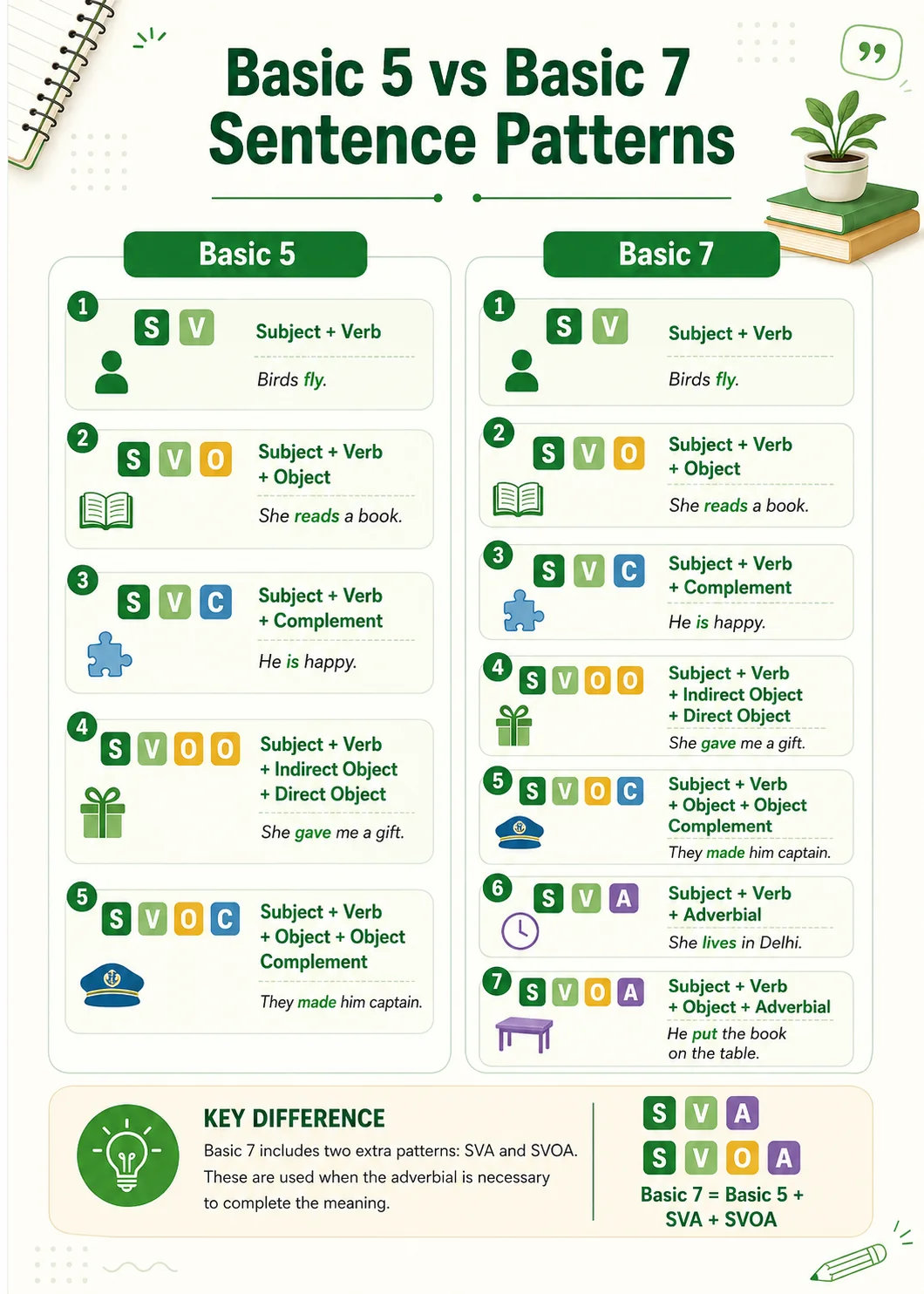
Some books teach 7 basic sentence patterns instead of 5.
The basic 7 are:
- SV
- SVO
- SVC
- SVOO
- SVOC
- SVA
- SVOA
The extra two patterns are:
- SVA = Subject + Verb + Adverbial
- SVOA = Subject + Verb + Object + Adverbial
Why are these added?
Because in some sentences, the adverbial is not optional. It is required to complete the meaning.
Examples:
She lives in Chennai.
Pattern:
SVA
Here, in Chennai is necessary in ordinary use because lives means “resides.”
Another example:
He put the book on the table.
Pattern:
SVOA
Here, on the table is necessary. The sentence He put the book feels incomplete.
So, the 7-pattern model gives a clearer explanation of sentences where place, direction, or position is required.
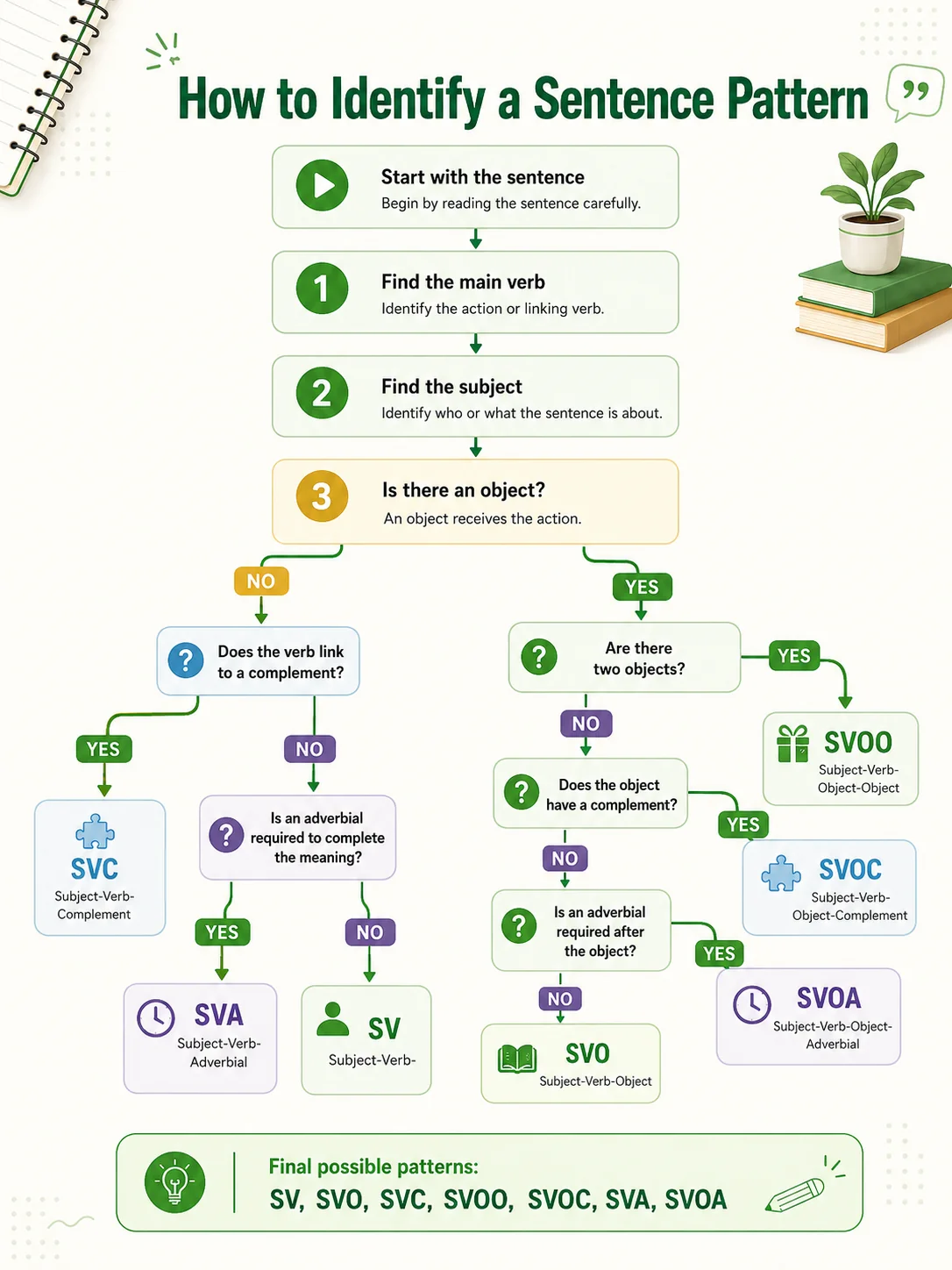
The basic 7 include the basic 5 plus two patterns with obligatory adverbials.
| No. | Pattern | Full Form |
|---|---|---|
| 1 | SV | Subject + Verb |
| 2 | SVO | Subject + Verb + Object |
| 3 | SVC | Subject + Verb + Complement |
| 4 | SVOO | Subject + Verb + Indirect Object + Direct Object |
| 5 | SVOC | Subject + Verb + Object + Object Complement |
| 6 | SVA | Subject + Verb + Adverbial |
| 7 | SVOA | Subject + Verb + Object + Adverbial |
We have already discussed the first five. Now let us study the two additional patterns.
The sixth pattern is:
Subject + Verb + Adverbial
In this pattern, the adverbial is necessary to complete the meaning.
Examples:
She lives in Chennai.
Subject: She
Verb: lives
Adverbial: in Chennai
Pattern: SVA
The book lies on the table.
Subject: The book
Verb: lies
Adverbial: on the table
Pattern: SVA
The meeting lasted for two hours.
Subject: The meeting
Verb: lasted
Adverbial: for two hours
Pattern: SVA
- He lives in Mumbai.
- She stayed at home.
- The children sat on the floor.
- The old man stood near the gate.
- The river flows through the village.
- The class begins at nine.
- The event lasted all day.
- My keys are in the drawer.
- live
- stay
- remain
- lie
- sit
- stand
- go
- come
- last
- begin
- end
- happen
- take place
- be
Compare:
Birds fly in the sky.
Core:
Birds fly.
Pattern:
SV
The phrase in the sky is optional.
Now compare:
She lives in Delhi.
If we remove in Delhi, the sentence She lives has a different or incomplete meaning in ordinary use.
So:
She lives in Delhi.
Pattern:
SVA
Another comparison:
| Sentence | Pattern | Reason |
|---|---|---|
| The baby slept on the sofa. | SV + optional A | The baby slept is complete. |
| The book lies on the sofa. | SVA | The place is needed. |
| Birds fly in the morning. | SV + optional A | Birds fly is complete. |
| The meeting lasted for an hour. | SVA | Duration completes the meaning. |
Sometimes a sentence can be grammatical in one context but incomplete in another.
For example:
She lives.
This can mean:
She is alive.
In that meaning, it can be SV.
But if the intended meaning is “resides,” we normally need a place:
She lives in Kolkata.
That is why sentence pattern analysis depends on meaning, not just word order.
The seventh pattern is:
Subject + Verb + Object + Adverbial
In this pattern, the verb takes an object and also needs an adverbial.
Example:
He put the book on the table.
Subject: He
Verb: put
Object: the book
Adverbial: on the table
Pattern: SVOA
The sentence feels incomplete without the adverbial:
He put the book.
We naturally ask:
Where did he put the book?
So, on the table is necessary.
She placed the vase near the window.
Subject: She
Verb: placed
Object: the vase
Adverbial: near the window
They kept the money in a box.
Subject: They
Verb: kept
Object: the money
Adverbial: in a box
He laid the baby on the bed.
Subject: He
Verb: laid
Object: the baby
Adverbial: on the bed
Please put your bag under the desk.
Implied subject: you
Verb: put
Object: your bag
Adverbial: under the desk
- put
- place
- keep
- lay
- set
- send
- take
- move
- carry
- bring
- drive
- lead
Compare:
She read the book in the library.
Core:
She read the book.
Pattern:
SVO
The adverbial in the library is optional.
Now compare:
She put the book in the bag.
Core without adverbial:
She put the book.
This feels incomplete.
So the pattern is:
SVOA
This is another important confusion point.
Compare:
She kept the money in a box.
Pattern:
SVOA
Here, in a box tells where she kept the money.
Now compare:
She kept the room clean.
Pattern:
SVOC
Here, clean describes the room.
More comparisons:
| Sentence | Pattern | Explanation |
|---|---|---|
| He put the keys on the shelf. | SVOA | On the shelf tells place. |
| He made the keys shiny. | SVOC | Shiny describes the keys. |
| She kept the child indoors. | SVOA or SVOC depending on analysis | Indoors can be analyzed as location or resulting state. |
| She kept the child happy. | SVOC | Happy describes the child. |
| They placed the chair near the door. | SVOA | Near the door tells place. |
| They painted the chair red. | SVOC | Red describes the chair. |
Some sentences can be analyzed differently depending on the grammar system and the exact meaning. But for learners, the basic difference is:
- SVOA: the final part tells place, direction, position, or similar information.
- SVOC: the final part describes or identifies the object.
The basic 5 and basic 7 are not enemies. They are two ways of explaining English sentence structure.
The basic 5 model is simpler.
The basic 7 model is more complete for certain verbs.
| Feature | Basic 5 | Basic 7 |
|---|---|---|
| Number of patterns | 5 | 7 |
| Includes SV | Yes | Yes |
| Includes SVO | Yes | Yes |
| Includes SVC | Yes | Yes |
| Includes SVOO | Yes | Yes |
| Includes SVOC | Yes | Yes |
| Includes SVA | No, usually treated as SV + adverbial | Yes |
| Includes SVOA | No, usually treated as SVO + adverbial | Yes |
| Best for | Beginners | More detailed analysis |
| Main issue | May ignore obligatory adverbials | Handles obligatory adverbials clearly |
Sentence:
She lives in Delhi.
Basic 5 analysis may say:
SV + adverbial
Basic 7 analysis says:
SVA
Why?
Because in Delhi is necessary in the ordinary meaning of lives.
Sentence:
He put the book on the table.
Basic 5 analysis may say:
SVO + adverbial
Basic 7 analysis says:
SVOA
Why?
Because on the table is necessary after put.
For beginners, learn the basic 5 first:
- SV
- SVO
- SVC
- SVOO
- SVOC
Then add:
- SVA
- SVOA
This gives you a clear and complete understanding.
A practical learning order is:
- Learn subject and verb.
- Learn object.
- Learn complement.
- Learn indirect object and direct object.
- Learn object complement.
- Learn optional and obligatory adverbials.
- Learn SVA and SVOA.
| Pattern | Full Form | Verb Type | Example | Key Question |
|---|---|---|---|---|
| SV | Subject + Verb | Intransitive | The baby slept. | Who/what did the action? |
| SVO | Subject + Verb + Object | Transitive | She opened the door. | Opened what? |
| SVC | Subject + Verb + Complement | Linking | He is honest. | What is the subject like? |
| SVOO | Subject + Verb + Indirect Object + Direct Object | Ditransitive | He gave me a pen. | Gave what to whom? |
| SVOC | Subject + Verb + Object + Object Complement | Complex transitive | They made him captain. | What did the object become? |
| SVA | Subject + Verb + Adverbial | Verb requiring adverbial | She lives in Delhi. | Lives where? |
| SVOA | Subject + Verb + Object + Adverbial | Verb requiring object + adverbial | He put the book on the table. | Put what where? |
When you see a sentence, do not try to label every word immediately. First, find the core.
The verb is the center of the sentence.
Example:
The little boy in the red shirt quickly opened the wooden door.
Main verb:
opened
Ignore extra describing words for now.
Ask:
Who or what opened?
Answer:
The little boy in the red shirt
Subject:
The little boy in the red shirt
Core subject:
boy
Ask:
Opened what?
Answer:
the wooden door
So, the wooden door is the object.
Pattern:
SVO
Full sentence:
The little boy in the red shirt quickly opened the wooden door.
Core:
boy opened door
Pattern:
SVO
The extra words give more detail:
- little = adjective
- in the red shirt = prepositional phrase describing boy
- quickly = adverbial
- wooden = adjective
But the basic pattern remains SVO.
Ask:
- Is the verb intransitive?
- Is it transitive?
- Is it linking?
- Does it take two objects?
- Does it take an object complement?
- Does it require an adverbial?
The verb type often reveals the pattern.
Examples:
| Verb Use | Sentence | Pattern |
|---|---|---|
| Intransitive | She laughed. | SV |
| Transitive | She read a book. | SVO |
| Linking | She became famous. | SVC |
| Ditransitive | She gave him advice. | SVOO |
| Complex transitive | They made her leader. | SVOC |
| Requires adverbial | She lives in Jaipur. | SVA |
| Requires object + adverbial | He put it on the shelf. | SVOA |
A derived structure is a sentence form created by changing, expanding, combining, or transforming a basic sentence pattern.
Basic sentence:
She wrote a letter.
Pattern:
SVO
Derived structures:
She did not write a letter.
Negative sentence.
Did she write a letter?
Question.
A letter was written by her.
Passive voice.
The letter that she wrote was long.
Relative clause.
She wrote a letter because she missed her friend.
Complex sentence.
The basic idea remains connected to the original pattern, but the structure changes.
Derived structures help us express:
- Negation
- Questions
- Emphasis
- Passive meaning
- Commands
- Exclamations
- Cause and effect
- Time relationships
- Conditions
- Description
- Complex ideas
A negative sentence says that something is not true, not happening, or not done.
Most negative sentences use:
auxiliary verb + not
Examples:
She is happy.
Negative:
She is not happy.
They have finished the work.
Negative:
They have not finished the work.
He can swim.
Negative:
He cannot swim.
In the simple present and simple past, when there is no auxiliary verb, English usually uses do, does, or did.
Example:
She writes letters.
Negative:
She does not write letters.
Not:
She not writes letters.
Example:
He opened the door.
Negative:
He did not open the door.
Not:
He not opened the door.
| Pattern | Positive | Negative |
|---|---|---|
| SV | Birds fly. | Birds do not fly at night. |
| SVO | She opened the door. | She did not open the door. |
| SVC | He is happy. | He is not happy. |
| SVOO | He gave me the book. | He did not give me the book. |
| SVOC | They made him captain. | They did not make him captain. |
| SVA | She lives here. | She does not live here. |
| SVOA | He put the file on the desk. | He did not put the file on the desk. |
Incorrect:
He not goes to school.
Correct:
He does not go to school.
Incorrect:
She does not goes there.
Correct:
She does not go there.
Incorrect:
They did not went home.
Correct:
They did not go home.
After do, does, did, use the base form of the main verb.
An interrogative sentence asks a question.
There are two main types:
- Yes/no questions
- Wh-questions
A yes/no question can be answered with yes or no.
Statement:
She is happy.
Question:
Is she happy?
Statement:
They are ready.
Question:
Are they ready?
Statement:
He can swim.
Question:
Can he swim?
Statement:
They have finished the work.
Question:
Have they finished the work?
Statement:
She likes tea.
Question:
Does she like tea?
Statement:
He opened the door.
Question:
Did he open the door?
| Pattern | Statement | Question |
|---|---|---|
| SV | The baby slept. | Did the baby sleep? |
| SVO | She wrote a letter. | Did she write a letter? |
| SVC | He is honest. | Is he honest? |
| SVOO | She gave him a gift. | Did she give him a gift? |
| SVOC | They made her leader. | Did they make her leader? |
| SVA | She lives in Pune. | Does she live in Pune? |
| SVOA | He put the bag on the chair. | Did he put the bag on the chair? |
Wh-questions ask for specific information.
Common question words:
- who
- whom
- whose
- what
- which
- where
- when
- why
- how
Examples:
She lives in Delhi.
Question:
Where does she live?
He gave her a gift.
Question:
What did he give her?
They made him captain.
Question:
What did they make him?
The teacher taught us grammar.
Question:
What did the teacher teach us?
When the question word is the subject, we usually do not use do-support.
Statement:
Rahul opened the door.
Question:
Who opened the door?
Not:
Who did open the door?
Statement:
Something happened.
Question:
What happened?
Incorrect:
Where she lives?
Correct:
Where does she live?
Incorrect:
What he gave you?
Correct:
What did he give you?
Incorrect:
Why you are late?
Correct:
Why are you late?
The passive voice changes the focus of the sentence.
In active voice, the subject does the action.
Active:
She opened the door.
In passive voice, the object of the active sentence becomes the subject.
Passive:
The door was opened by her.
The basic passive structure is:
be + past participle
Examples:
| Active | Passive |
|---|---|
| She writes a letter. | A letter is written by her. |
| She wrote a letter. | A letter was written by her. |
| She is writing a letter. | A letter is being written by her. |
| She has written a letter. | A letter has been written by her. |
| She will write a letter. | A letter will be written by her. |
Active:
The boy broke the window.
Pattern:
SVO
Passive:
The window was broken by the boy.
Active:
He gave me a book.
There are two possible passive forms:
I was given a book.
or:
A book was given to me.
Both are possible, but the first one is common when the indirect object is made the subject.
Active:
They elected him president.
Passive:
He was elected president.
Active:
People considered her honest.
Passive:
She was considered honest.
SV has no object.
The baby slept.
There is no object to become the subject of the passive sentence.
So we cannot normally say:
The baby was slept.
SVC also has no object.
She is happy.
There is no object to make passive.
So we cannot say:
Happy is been by her.
That is incorrect.
Incorrect:
The accident was happened.
Correct:
The accident happened.
The verb happen is intransitive. It does not usually form a passive.
Incorrect:
He was slept.
Correct:
He slept.
Incorrect:
The book was belonged to me.
Correct:
The book belonged to me.
The verb belong is not normally used in passive voice.
An imperative sentence gives a command, instruction, request, or advice.
Examples:
- Sit down.
- Open the door.
- Please listen carefully.
- Give me the pen.
- Keep the room clean.
- Put the bag on the table.
In imperative sentences, the subject you is usually understood.
Example:
Open the door.
Full meaning:
You open the door.
Pattern:
SVO
| Imperative | Understood Full Form | Pattern |
|---|---|---|
| Sit down. | You sit down. | SVA or SV + A |
| Open the door. | You open the door. | SVO |
| Give me the book. | You give me the book. | SVOO |
| Keep it safe. | You keep it safe. | SVOC |
| Put it there. | You put it there. | SVOA |
| Be quiet. | You be quiet. | SVC |
Use:
Do not + base verb
Examples:
- Do not shout.
- Do not open the window.
- Do not put your bag there.
- Do not be late.
In conversation, do not often becomes don’t:
- Don’t shout.
- Don’t be careless.
An exclamatory sentence expresses strong feeling.
Examples:
What a beautiful day it is!
How kind she is!
Use what before a noun phrase.
Examples:
What a lovely flower it is!
Underlying sentence:
It is a lovely flower.
Pattern:
SVC
What an interesting story she told!
Underlying sentence:
She told an interesting story.
Pattern:
SVO
Use how before an adjective or adverb.
Examples:
How beautiful the sky is!
Underlying sentence:
The sky is beautiful.
Pattern:
SVC
How quickly he runs!
Underlying sentence:
He runs quickly.
Pattern:
SV + optional adverbial
A compound sentence has two or more independent clauses joined together.
Common coordinating conjunctions:
- and
- but
- or
- so
- yet
- for
- nor
Example:
She cooked dinner, and he washed the dishes.
This sentence has two independent clauses:
- She cooked dinner.
- He washed the dishes.
Analysis:
| Clause | Pattern |
|---|---|
| She cooked dinner | SVO |
| he washed the dishes | SVO |
The baby cried, but the mother stayed calm.
Clause 1:
The baby cried.
Pattern:
SV
Clause 2:
the mother stayed calm.
Pattern:
SVC
I wanted to go outside, but it was raining.
Clause 1:
I wanted to go outside.
Pattern:
SVO
Clause 2:
it was raining.
Pattern:
SV
Each independent clause has its own sentence pattern.
A compound sentence is not just one pattern. It is a combination of patterns.
A complex sentence has one independent clause and at least one dependent clause.
Example:
She stayed home because it was raining.
Independent clause:
She stayed home.
Pattern:
SVA
Dependent clause:
because it was raining
Inside the dependent clause:
it was raining
Pattern:
SV
- because
- although
- if
- when
- while
- after
- before
- since
- unless
- until
- as
- though
I will call you when I arrive.
Main clause:
I will call you.
Pattern:
SVO
Dependent clause:
when I arrive
Inside it:
I arrive.
Pattern:
SV
Although he was tired, he finished the work.
Dependent clause:
Although he was tired
Inside it:
he was tired
Pattern:
SVC
Main clause:
he finished the work
Pattern:
SVO
A dependent clause cannot usually stand alone as a complete sentence.
Fragment:
Because it was raining.
Complete sentence:
We stayed inside because it was raining.
Fragment:
Although he was tired.
Complete sentence:
Although he was tired, he continued working.
A compound-complex sentence has:
- two or more independent clauses
- at least one dependent clause
Example:
She wanted to join the class, but she stayed home because she was sick.
Independent clause 1:
She wanted to join the class.
Pattern:
SVO
Independent clause 2:
she stayed home
Pattern:
SVA
Dependent clause:
because she was sick
Inside it:
she was sick
Pattern:
SVC
I called him when I reached the station, but he did not answer the phone.
Clause 1:
I called him
Pattern:
SVO
Dependent clause:
when I reached the station
Inside it:
I reached the station
Pattern:
SVO
Clause 2:
he did not answer the phone
Pattern:
SVO negative
Compound-complex sentences look long, but they are made from smaller clause patterns.
A relative clause gives more information about a noun.
Common relative words:
- who
- whom
- whose
- which
- that
- where
- when
Example:
The boy who won the prize is my friend.
Main clause:
The boy is my friend.
Pattern:
SVC
Relative clause:
who won the prize
Inside the relative clause:
who won the prize
Pattern:
SVO
Here, who refers to the boy.
The book that I bought is expensive.
Main clause:
The book is expensive.
Pattern:
SVC
Relative clause:
that I bought
Inside it:
I bought that.
Pattern:
SVO
The woman who lives next door is a doctor.
Main clause:
The woman is a doctor.
Pattern:
SVC
Relative clause:
who lives next door
Pattern:
SVA
Incorrect:
The boy who he won the prize is my friend.
Correct:
The boy who won the prize is my friend.
Why?
Because who already works as the subject of the relative clause. We do not need he.
Incorrect:
The book which I bought it is expensive.
Correct:
The book which I bought is expensive.
Why?
Because which already represents the object of bought. We do not need it.
A noun clause is a clause that works like a noun.
It can be:
- Subject
- Object
- Complement
What he said surprised me.
Subject:
What he said
Verb:
surprised
Object:
me
Pattern of the whole sentence:
SVO
Inside the noun clause:
he said what
Pattern:
SVO
I know that she is honest.
Subject:
I
Verb:
know
Object:
that she is honest
Pattern:
SVO
Inside the noun clause:
she is honest
Pattern:
SVC
The truth is that we were late.
Subject:
The truth
Verb:
is
Complement:
that we were late
Pattern:
SVC
Inside the noun clause:
we were late
Pattern:
SVC
- that
- what
- whether
- if
- who
- whom
- whose
- which
- when
- where
- why
- how
Examples:
- I do not know where he lives.
- She asked whether I was ready.
- What you said is important.
- The problem is that we are late.
Basic sentences can become longer by adding phrases.
A phrase does not usually have both a subject and a finite verb, but it adds meaning.
The boy smiled.
Pattern:
SV
The little boy in the blue shirt smiled warmly at his mother.
Core:
boy smiled
Pattern:
SV
Extra parts:
- little = adjective
- in the blue shirt = prepositional phrase describing boy
- warmly = adverbial of manner
- at his mother = adverbial or complement depending on verb use
The very tall boy smiled.
Adjective phrase:
very tall
It describes boy.
She spoke very softly.
Adverb phrase:
very softly
It describes how she spoke.
The cat under the table is sleeping.
Prepositional phrase:
under the table
It describes the cat.
She went to the library to study.
Infinitive phrase:
to study
It tells purpose.
Shocked by the news, she sat down.
Participle phrase:
Shocked by the news
It describes she.
Long sentences often have a simple core.
Example:
The young girl with curly hair from the small village near the river wrote a beautiful poem about her childhood.
Core:
girl wrote poem
Pattern:
SVO
A non-finite verb does not show tense by itself.
Main types:
- Infinitive
- Gerund
- Participle
An infinitive usually has:
to + base verb
Examples:
- to read
- to write
- to learn
- to improve
She wants to learn English.
Subject:
She
Verb:
wants
Object:
to learn English
Pattern:
SVO
To learn English takes time.
Subject:
To learn English
Verb:
takes
Object:
time
Pattern:
SVO
He went to the library to study.
Main pattern:
He went to the library.
Pattern:
SVA
Purpose phrase:
to study
A gerund is the -ing form of a verb used like a noun.
Examples:
- reading
- writing
- swimming
- learning
Swimming is healthy.
Subject:
Swimming
Verb:
is
Complement:
healthy
Pattern:
SVC
He enjoys reading.
Subject:
He
Verb:
enjoys
Object:
reading
Pattern:
SVO
She is interested in learning grammar.
Preposition:
in
Gerund phrase:
learning grammar
Participles are verb forms used like adjectives or in verb phrases.
There are two common types:
- Present participle: -ing form
- Past participle: usually -ed, -en, or irregular form
The crying baby woke up.
Modifier:
crying
It describes baby.
The broken window was repaired.
Modifier:
broken
It describes window.
Tired after the journey, she went to bed.
Participle phrase:
Tired after the journey
It describes she.
Main clause:
she went to bed
Pattern:
SVA
A cleft sentence divides one sentence into two parts to emphasize one part.
Basic sentence:
Riya broke the vase.
Pattern:
SVO
Cleft sentence:
It was Riya who broke the vase.
This emphasizes Riya.
Another cleft:
It was the vase that Riya broke.
This emphasizes the vase.
It + be + focused element + who/that clause
Examples:
It was my brother who called you.
Original:
My brother called you.
Pattern:
SVO
It was yesterday that I met him.
Original:
I met him yesterday.
Pattern:
SVO + optional adverbial
Cleft sentences are used for emphasis.
Compare:
She bought the red dress.
This is neutral.
It was the red dress that she bought.
This emphasizes the red dress, not another dress.
Inversion means changing the normal order of subject and auxiliary verb.
Normal order:
Subject + auxiliary
Inverted order:
Auxiliary + subject
Inversion is common in questions.
Statement:
She is ready.
Question:
Is she ready?
But inversion is also used in some advanced structures.
Normal:
I have never seen such beauty.
Inverted:
Never have I seen such beauty.
Other examples:
Rarely do we get such an opportunity.
Hardly had he arrived when it started raining.
Normal:
If I had known the truth, I would have helped.
Inverted:
Had I known the truth, I would have helped.
Normal:
If you should need help, call me.
Inverted:
Should you need help, call me.
In literary or formal style:
On the wall hung a beautiful painting.
Normal:
A beautiful painting hung on the wall.
Inversion changes word order for questions, emphasis, or style. The underlying meaning still comes from basic sentence patterns.
Ellipsis means leaving out words that are understood from the context.
Example:
She can play the guitar, and he can too.
Full meaning:
She can play the guitar, and he can play the guitar too.
The repeated words are omitted.
Want some tea?
Full form:
Do you want some tea?
Coming?
Full form:
Are you coming?
I ordered coffee, and she tea.
Full form:
I ordered coffee, and she ordered tea.
Ellipsis is common in:
- Conversation
- Informal writing
- Repeated structures
- Short answers
Examples:
Question:
Are you ready?
Answer:
Yes, I am.
Full meaning:
Yes, I am ready.
Question:
Who opened the door?
Answer:
Rahul.
Full meaning:
Rahul opened the door.
Even when words are omitted, the full pattern is understood from context.
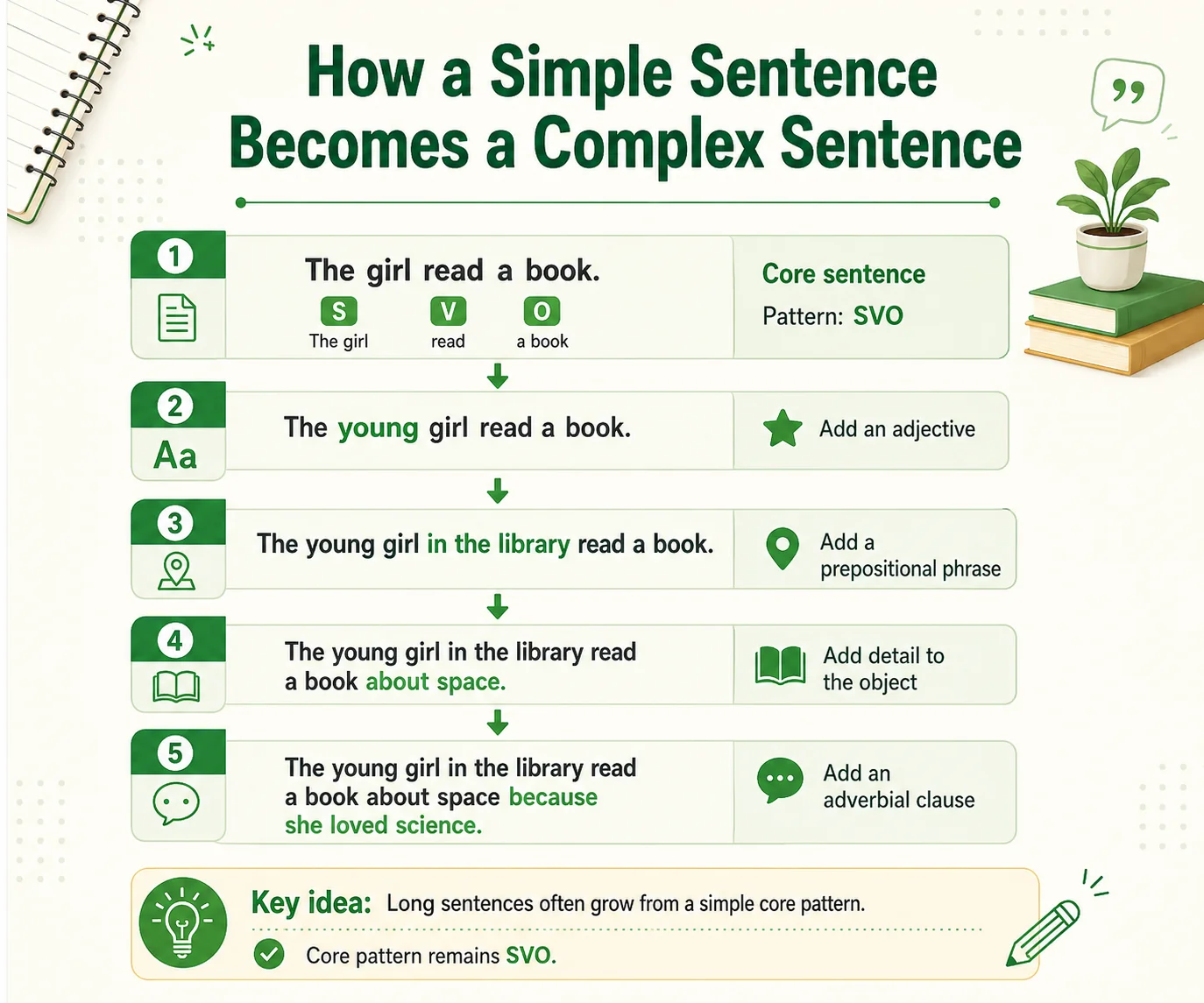
Many learners become afraid of long sentences. But long sentences often grow from short basic sentences.
Let us begin with a simple sentence:
The girl read a book.
Pattern:
SVO
Now expand it step by step.
The young girl read a book.
Core:
girl read book
Pattern:
SVO
The young girl in the library read a book.
Core:
girl read book
Pattern:
SVO
The young girl in the library read a book about space.
Core:
girl read book
Pattern:
SVO
The young girl in the library read a book about space because she loved science.
Main clause:
The young girl in the library read a book about space.
Core:
girl read book
Pattern:
SVO
Dependent clause:
because she loved science
Inside it:
she loved science
Pattern:
SVO
The young girl who lived near the school read a book about space because she loved science.
Main core:
girl read book
Pattern:
SVO
Relative clause:
who lived near the school
Pattern:
SVA
Adverbial clause:
because she loved science
Pattern:
SVO
The sentence is long, but it is made of smaller patterns.
Let us solve the most common problems learners face.
Compare:
She met a doctor.
Pattern:
SVO
A doctor is the object. She met someone.
Now compare:
She became a doctor.
Pattern:
SVC
A doctor is the complement. It identifies the subject.
Simple test:
- If the noun receives the action, it is an object.
- If the noun identifies the subject, it is a complement.
More examples:
| Sentence | Correct Analysis |
|---|---|
| He found a wallet. | Wallet = object |
| He found the task difficult. | Difficult = object complement |
| She is a singer. | Singer = subject complement |
| She heard a singer. | Singer = object |
Example:
He gave me a pen.
Ask:
Gave what?
Answer:
a pen
So, a pen is the direct object.
Ask:
Gave a pen to whom?
Answer:
me
So, me is the indirect object.
More examples:
| Sentence | Indirect Object | Direct Object |
|---|---|---|
| She sent him a message. | him | a message |
| They offered us help. | us | help |
| My mother told me a story. | me | a story |
| The teacher gave the class homework. | the class | homework |
Compare:
They gave him a prize.
Pattern:
SVOO
He receives a prize.
Now compare:
They called him a hero.
Pattern:
SVOC
A hero describes him.
In SVOO, the two objects are not equal.
him ≠ a prize
In SVOC, the object and complement are connected.
him = a hero
More examples:
| SVOO | SVOC |
|---|---|
| She gave him money. | She made him angry. |
| He sent her flowers. | He found her intelligent. |
| They offered me a job. | They considered me lucky. |
| My aunt bought me a watch. | My aunt called me careless. |
Compare:
She sang beautifully.
Remove beautifully:
She sang.
Still complete.
So, beautifully is optional.
Now compare:
She lives in Patna.
Remove in Patna:
She lives.
This may be grammatical in a different meaning, but if we mean “resides,” it needs a place.
So, in Patna is obligatory.
Another example:
He put the phone on the table.
Remove on the table:
He put the phone.
Incomplete.
So, on the table is obligatory.
The same verb can behave differently in different sentences.
Example:
She looked tired.
Here, looked is a linking verb.
Pattern:
SVC
Tired describes she.
Now compare:
She looked at the sky.
Here, looked is an action verb followed by a prepositional phrase.
Pattern may be analyzed as:
SVA
or:
SV + adverbial
depending on the grammar system.
Another example:
The soup tasted salty.
Pattern:
SVC
Salty describes the soup.
I tasted the soup.
Pattern:
SVO
The soup is the object of tasted.
So, do not classify a verb by memorizing it only. Look at how it is used in the sentence.
Try to identify the pattern of each sentence before checking the answers.
- The baby slept.
- She opened the window.
- He is a doctor.
- My mother gave me advice.
- They painted the wall blue.
- She lives in Kolkata.
- He put the keys on the shelf.
- The soup tastes salty.
- We found the test difficult.
- The teacher told the students a story.
- Birds fly.
- I bought a new phone.
- The children became quiet.
- She sent her friend a message.
- They elected him president.
- The meeting lasted for two hours.
- Please keep the room clean.
- The cat sat under the table.
- He placed the flowers in a vase.
- The news made everyone happy.
Subject: The baby
Verb: slept
Pattern: SV
The verb slept is intransitive.
Subject: She
Verb: opened
Object: the window
Pattern: SVO
Opened what? The window.
Subject: He
Verb: is
Complement: a doctor
Pattern: SVC
A doctor identifies the subject.
Subject: My mother
Verb: gave
Indirect object: me
Direct object: advice
Pattern: SVOO
Gave what? Advice.
To whom? Me.
Subject: They
Verb: painted
Object: the wall
Object complement: blue
Pattern: SVOC
Blue describes the wall.
Subject: She
Verb: lives
Adverbial: in Kolkata
Pattern: SVA
The place is necessary in the ordinary meaning of lives.
Subject: He
Verb: put
Object: the keys
Adverbial: on the shelf
Pattern: SVOA
Put what where? The keys on the shelf.
Subject: The soup
Verb: tastes
Complement: salty
Pattern: SVC
Salty describes the soup.
Subject: We
Verb: found
Object: the test
Object complement: difficult
Pattern: SVOC
Difficult describes the test.
Subject: The teacher
Verb: told
Indirect object: the students
Direct object: a story
Pattern: SVOO
Told what? A story.
To whom? The students.
Subject: Birds
Verb: fly
Pattern: SV
No object is needed.
Subject: I
Verb: bought
Object: a new phone
Pattern: SVO
Bought what? A new phone.
Subject: The children
Verb: became
Complement: quiet
Pattern: SVC
Quiet describes the children.
Subject: She
Verb: sent
Indirect object: her friend
Direct object: a message
Pattern: SVOO
Sent what? A message.
To whom? Her friend.
Subject: They
Verb: elected
Object: him
Object complement: president
Pattern: SVOC
President identifies him.
Subject: The meeting
Verb: lasted
Adverbial: for two hours
Pattern: SVA
The duration completes the meaning.
Understood subject: you
Verb: keep
Object: the room
Object complement: clean
Pattern: SVOC
Clean describes the room.
Subject: The cat
Verb: sat
Adverbial: under the table
Pattern: SVA or SV + A
This depends on analysis. If the place is considered necessary for the intended meaning, use SVA. If the sentence The cat sat is considered complete, use SV + optional adverbial.
Subject: He
Verb: placed
Object: the flowers
Adverbial: in a vase
Pattern: SVOA
Placed what where? The flowers in a vase.
Subject: The news
Verb: made
Object: everyone
Object complement: happy
Pattern: SVOC
Happy describes everyone.
Sentence patterns become easier when they are taught in the right order.
These three patterns are the foundation.
Examples:
- Birds fly. = SV
- She reads books. = SVO
- She is intelligent. = SVC
Once learners understand these, they can move to more complex patterns.
Do not only ask students to memorize labels.
Teach them that:
- Intransitive verbs form SV.
- Transitive verbs form SVO.
- Linking verbs form SVC.
- Ditransitive verbs form SVOO.
- Complex transitive verbs form SVOC.
- Some verbs require adverbials and form SVA or SVOA.
You can use colors to make sentence parts clear.
Example color system:
- Subject = blue
- Verb = red
- Object = green
- Complement = purple
- Adverbial = orange
Sentence:
She put the book on the table.
Analysis:
- She = Subject
- put = Verb
- the book = Object
- on the table = Adverbial
Pattern:
SVOA
Teach learners to remove extra modifiers.
Long sentence:
The intelligent young student from a small village solved the difficult problem quickly.
Core:
student solved problem
Pattern:
SVO
This method helps learners avoid confusion.
Comparison pairs are very useful.
Examples:
She became a teacher.
She met a teacher.
First sentence:
SVC
Second sentence:
SVO
Another pair:
They gave him a prize.
They made him leader.
First sentence:
SVOO
Second sentence:
SVOC
Use pairs:
She slept on the sofa.
Core:
She slept.
Pattern:
SV + optional adverbial
She lives in Chennai.
Core without place:
She lives.
Different or incomplete meaning in ordinary use.
Pattern:
SVA
Sentence pattern analysis is not only about word order. It is also about meaning.
Example:
She looked happy.
Pattern:
SVC
She looked at me.
Pattern:
SVA or SV + A
The same verb can create different patterns.
English sentence patterns are the basic frameworks used to build sentences.
The five main elements are:
- Subject
- Verb
- Object
- Complement
- Adverbial
The basic 5 sentence patterns are:
-
SV — Subject + Verb
Example: Birds fly. -
SVO — Subject + Verb + Object
Example: She opened the door. -
SVC — Subject + Verb + Complement
Example: He is honest. -
SVOO — Subject + Verb + Indirect Object + Direct Object
Example: She gave me a gift. -
SVOC — Subject + Verb + Object + Object Complement
Example: They made him captain.
The basic 7 sentence patterns add two more:
-
SVA — Subject + Verb + Adverbial
Example: She lives in Delhi. -
SVOA — Subject + Verb + Object + Adverbial
Example: He put the book on the table.
The main difference between the basic 5 and the basic 7 is the treatment of obligatory adverbials.
In the basic 5 model, adverbials are often treated as extra information.
In the basic 7 model, necessary adverbials are treated as part of the core pattern.
Derived structures are formed when we transform, expand, or combine basic patterns.
Examples of derived structures include:
- Negative sentences
- Questions
- Passive voice
- Imperatives
- Exclamations
- Compound sentences
- Complex sentences
- Relative clauses
- Noun clauses
- Cleft sentences
- Inversion
- Ellipsis
The most important skill is to find the core sentence first. Long sentences become much easier when you reduce them to their basic pattern.
The basic 5 sentence patterns are:
- SV — Subject + Verb
- SVO — Subject + Verb + Object
- SVC — Subject + Verb + Complement
- SVOO — Subject + Verb + Indirect Object + Direct Object
- SVOC — Subject + Verb + Object + Object Complement
Examples:
- Birds fly. = SV
- She read a book. = SVO
- He is happy. = SVC
- She gave me a pen. = SVOO
- They made him captain. = SVOC
The basic 7 sentence patterns are:
- SV
- SVO
- SVC
- SVOO
- SVOC
- SVA
- SVOA
The two additional patterns are:
- SVA: She lives in Delhi.
- SVOA: He put the book on the table.
These two patterns include obligatory adverbials.
Some books teach 5 patterns to keep sentence structure simple for beginners. In this system, adverbials are often treated as extra information.
Other books teach 7 patterns because some adverbials are necessary to complete the meaning of the verb.
Example:
He put the book on the table.
Without on the table, the sentence feels incomplete:
He put the book.
That is why the 7-pattern model includes SVOA.
An object receives the action of the verb.
Example:
She met a doctor.
Here, a doctor is the object.
A complement describes or identifies the subject or object.
Example:
She became a doctor.
Here, a doctor is a subject complement because it identifies she.
The direct object is the thing or person directly affected by the verb.
The indirect object is the receiver or beneficiary of the direct object.
Example:
He gave me a pen.
Direct object:
a pen
Indirect object:
me
He gave what? A pen.
To whom? Me.
An indirect object receives the direct object.
Example:
She gave him a gift.
Here, him receives a gift.
An object complement describes or identifies the object.
Example:
They made him leader.
Here, leader identifies him.
An optional adverbial can be removed, and the sentence still remains complete.
Example:
She sang beautifully.
Remove beautifully:
She sang.
Still complete.
An obligatory adverbial is necessary to complete the meaning.
Example:
He put the keys on the table.
Remove on the table:
He put the keys.
Incomplete.
Most simple independent clauses can be analyzed using these basic patterns. However, real English sentences can become more complex because of coordination, subordination, ellipsis, idioms, phrasal verbs, and special constructions.
Still, learning these patterns gives you a strong foundation for understanding sentence structure.
Yes. A sentence with more than one clause can contain more than one pattern.
Example:
She stayed home because it was raining.
Main clause:
She stayed home. = SVA
Dependent clause:
it was raining. = SV
So one sentence can contain multiple clause patterns.
First, find the main verb. Then find the subject. After that, check whether the verb has an object, complement, or obligatory adverbial.
Also remove extra modifiers.
Example:
The young boy in the blue shirt quickly opened the old wooden door.
Core:
boy opened door
Pattern:
SVO
Passive sentences are usually derived structures because they are formed from active sentences.
Active:
She opened the door.
Pattern:
SVO
Passive:
The door was opened by her.
The object of the active sentence becomes the subject of the passive sentence.
Beginners should first learn:
- SV
- SVO
- SVC
After that, they can learn:
- SVOO
- SVOC
Then they should learn:
- SVA
- SVOA
This order moves from simple to more complex structures.
Yes. Many verbs can appear in different patterns depending on meaning.
Example:
She looked tired.
Pattern:
SVC
Here, looked is a linking verb.
She looked at the picture.
Pattern:
SVA or SV + adverbial
Here, looked is an action verb followed by a prepositional phrase.
Another example:
The soup tasted salty.
Pattern:
SVC
I tasted the soup.
Pattern:
SVO
So always study how the verb is used in the sentence.
Remember them in groups:
Simple action:
- SV: Birds fly.
Action with object:
- SVO: She reads books.
Description or identity:
- SVC: He is honest.
Giving or transferring:
- SVOO: She gave me a pen.
Object description:
- SVOC: They made him captain.
Required place or time:
- SVA: She lives in Delhi.
Required object and place:
- SVOA: He put the book on the table.
This meaning-based method is easier than memorizing labels alone.