The Difference Between "A" and "An" That Most Students Forget
The real rule behind a vs an — it's about sound, not spelling. Learn with examples, exceptions, and common exam traps.
Articles, Grammar Foundations
Posts tagged
95 posts
The real rule behind a vs an — it's about sound, not spelling. Learn with examples, exceptions, and common exam traps.
Master zero article rules — when to omit articles with general nouns, meals, languages, games, institutions, and proper nouns.
Master modal + have + past participle — for past deduction, regret, criticism, and missed possibilities.
Master adverbial clauses — time, reason, condition, contrast, purpose, and result — with subordinators, examples, and exam-focused practice.
Advice vs advise — the noun-verb pair with different pronunciation. Learn the rule and the spelling pattern.
Affect vs effect — the verb-noun rule, the rare exceptions, and a simple trick to get it right every time.
Beside means next to; besides means in addition to or moreover. Learn the difference with examples and common errors.
Between vs among — the simple two-vs-many rule, the exceptions with "between" for more than two, and common errors.
Both, either, and neither explained with two-option meaning, paired structures, agreement rules, common mistakes, and practice questions.
Understand the key grammar differences between British and American English — agreement, tenses, prepositions, and more for exams and writing.
Can vs may explained with ability, permission, possibility, formal usage, common mistakes, exam traps, and practice questions.
Learn causative verbs have, get, and make — how to use them for services, forcing, and arranging actions — with rules, examples, and practice for exams.
Learn cleft sentences in English — it-clefts and wh-clefts — to emphasize specific parts of a sentence, with rules, examples, and practice for exams.
Learn collective noun agreement with team, family, committee, government, and class, including BrE vs AmE usage, exam traps, common mistakes, and practice.
Master the comma rules that affect clarity — introductory elements, non-defining clauses, lists, and preventing misreading.
Learn all four English conditionals — zero, first, second, and third — with clear rules, patterns, examples, and practice for exams.
Learn all three types of conjunctions — coordinating, subordinating, and correlative — with rules, examples, and practice for exams.
Learn how to choose the correct tense in error spotting using time markers, sequence clues, aspect meaning, examples, and quick practice.
Master countable and uncountable nouns — advanced rules, dual-meaning nouns, quantifiers, and exceptions for exams and writing.
Learn dangling modifiers in English grammar: why opening phrases must clearly connect to the subject, with examples, exam traps, corrections, and practice.
Learn the difference between defining and non-defining relative clauses, when to use commas, which relative pronouns to choose, and how to avoid common errors.
Master the definite article "the" — when to use it, when to skip it, and the logic behind specific vs general reference.
Master determiners and quantifiers — few, a few, little, a little, much, many, and more — with clear rules on countability, meaning, and exam traps.
Learn double negatives in standard English: why sentences like I don't know nothing are wrong, how to correct them, and how to solve exam questions.
Each vs every explained with singular agreement, individual vs group meaning, common mistakes, exam traps, and practice questions.
Either vs neither explained with positive and negative choice rules, either-or and neither-nor patterns, agreement, common mistakes, and practice questions.
Learn how to eliminate wrong options in grammar MCQs using agreement rules, tense checks, article logic, and elimination strategies with examples and practice.
Learn ellipsis and substitution in English — how to omit or replace words to avoid repetition, with rules, examples, and practice for exams.
Learn how to use do/does/did for emphasis — to correct, insist, and add force to affirmative statements.
Learn common error spotting tricks for articles with clear rules, exam-style examples, common mistakes, and quick practice for a, an, the, and zero article.
Learn common error spotting tricks for prepositions with clear patterns, exam-style examples, common mistakes, and quick practice for sentence correction.
Learn common error spotting tricks for pronouns: case, agreement, clear reference, reflexive pronouns, examples, common mistakes, and practice.
Learn common error spotting tricks for tenses with time markers, sequence of actions, stative verbs, since/for patterns, examples, and practice.
Fewer vs less explained clearly — countable vs uncountable, the supermarket sign debate, and when the rule bends.
Learn how to solve fill-in-the-blank questions using grammar clues like subject-verb agreement, tense markers, collocations, and sentence logic with examples and practice.
Learn how to find the subject in a confusing sentence by removing extra phrases, clauses, and inverted structures, with examples and practice.
Understand when grammar rules are strict and when they bend — formal vs informal English for exams, essays, and everyday communication.
Learn the difference between future continuous and future perfect with clear rules, time markers, examples, and practice for exams.
Learn when to use gerunds vs infinitives in English — which verbs take which form, when both are possible, and how the meaning changes — with examples and practice.
Good is an adjective; well is usually an adverb. Learn the rule, the health exception, and why "I feel good" vs "I feel well" both work.
Discover which 'grammar rules' are actually myths — ending with prepositions, splitting infinitives, starting with and/but, and more.
Explore how English grammar evolved — from thou/thee to singular they, case loss, do-support, and what it means for modern usage.
Learn how to identify the main verb in a long sentence with clear rules, examples, common mistakes, and quick practice for error spotting and writing.
Master in, on, at for time and place — the general-to-specific rule with clear examples and common errors.
Master indirect questions — polite forms, statement word order, and common errors for exams and formal writing.
Learn inversion in English — how to use auxiliary-subject inversion after negative and adverbial fronting for emphasis — with rules, examples, and practice.
Its vs it's — the possessive-without-apostrophe rule, why it's confusing, and how to never mix them up again.
Lie vs lay — the intransitive/transitive rule, all four forms (lie/lay/lain vs lay/laid/laid), and how to never confuse them.
Master linking verbs — be, seem, become, look, taste, feel — and why they take adjectives, not adverbs.
May vs might explained with possibility, permission, hypothetical meaning, common mistakes, exam traps, and practice questions.
Learn misplaced modifiers in English grammar: how words like only, almost, and modifying phrases change meaning depending on placement, with examples and practice.
Learn mixed conditionals in English — when past conditions affect present results and present traits affect past outcomes — with rules, examples, and practice.
Learn when to use much vs many, how countable and uncountable nouns determine the choice, and the exceptions in questions and negatives.
Master noun clauses — how they work as subjects, objects, and complements — with clear rules, examples, and exam-focused practice.
Learn object complements — how verbs like make, call, find, consider, elect take complements that describe the direct object.
Learn the order of adjectives with clear rules, exam-focused examples, common mistakes, and quick practice for writing and error spotting.
Learn the rule of parallelism in English grammar: how to keep lists, paired structures, and comparisons grammatically balanced, with examples and practice.
Learn how to use participle clauses to reduce adverbial and relative clauses — with clear rules, examples, and common mistakes for exams.
Learn how to form passive voice in every English tense — present, past, future, perfect, and continuous — with rules, examples, and practice for exams.
Learn the difference between past perfect and past simple using the earlier-past signal, with clear rules, examples, and practice for exams.
Master phrasal verbs — separable, inseparable, transitive, and intransitive — with rules for pronoun placement, examples, and exam-focused practice.
Learn why scissors are, trousers are, and a pair of glasses is are correct, with rules for plural nouns with two parts, common errors, exam traps, and practice.
Master the possessive apostrophe with clear rules for singular, plural, and irregular nouns — plus common mistakes and exam-focused practice.
Practice vs practise — the British noun-verb distinction, why American English uses only one form, and what Indian exams expect.
Understand prepositional phrases — how they modify nouns (adjective function) and verbs/adverbs (adverb function) with examples.
Learn the difference between -ing and -ed adjectives — bored vs boring, interested vs interesting — with clear rules, examples, and exam practice.
Learn the difference between present perfect and past simple using the connection-to-now rule, time markers, examples, and quick practice for exams.
Master question formation — yes/no questions, wh- questions, tag questions, and indirect questions with rules and exam practice.
Learn redundancy in English grammar and writing: why phrases like return back, repeat again, final conclusion, and past history are weak or wrong.
Learn when to use reflexive pronouns correctly — myself, yourself, himself — with rules for emphasis, common mistakes, and exam-focused practice.
Master relative pronouns — whose, where, when, whereby — with clear rules for possession, place, time, and formal writing.
Learn reported speech backshift rules — how tenses, pronouns, and time words change, and when NOT to backshift — with examples and practice for exams.
Rise vs raise explained with the object rule, verb forms, common mistakes, exam traps, and quick practice.
Learn how to use semicolons, colons, and dashes correctly with clear rules, examples, common mistakes, and practice for exams.
Understand the four sentence types — simple, compound, complex, and compound-complex — with clear rules, examples, and exam-focused practice.
Should vs must explained with advice, obligation, confident deduction, common mistakes, exam traps, and practice questions.
Since vs for in present perfect tense — the difference between a starting point and a duration, with examples and exam tips.
Learn why news is, mathematics is, and measles is are correct, with rules for singular nouns that end in -s, common mistakes, exam traps, and practice.
When to use some vs any in statements, questions, and negatives — the simple rule and its important exceptions.
Learn stative verbs — why some verbs resist continuous tenses, with rules for states, thoughts, possession, and senses.
Learn subject-verb agreement with as well as, including why the verb agrees with the first subject, common exam traps, examples, and practice.
Learn subject-verb agreement with either/or and neither/nor, including the nearest-subject rule, person agreement, common exam traps, and practice.
Learn how subject-verb agreement works with one of, including one of my friends, one of the students, one of those people who, common mistakes, and practice.
Master the English subjunctive — base verb forms after demands/suggestions, 'were' in hypotheticals, with rules, examples, and exam practice.
Then vs than — one letter apart, completely different meanings. Learn the time-vs-comparison rule with examples.
There vs their vs they're — three homophones, three meanings, and a simple trick to never confuse them again.
Used to vs be used to explained with past habits, familiarity, gerunds, common mistakes, exam traps, and practice questions.
Which vs that — the restrictive vs non-restrictive clause rule, comma usage, and when the choice changes meaning.
Who vs whom made simple — the he/him trick, when to use each, and why whom is disappearing from everyday English.
Understand why "be" changes to am, is, are, was, were based on subject person and number. Clear rule with examples and common errors.
Will vs would explained with future meaning, past habit, polite requests, hypothetical results, reported speech, common mistakes, and practice questions.
Learn how to use wish and if only for present regrets, past regrets, and desired changes — with clear rules, examples, and practice for exams.
Learn how English words are formed using prefixes, suffixes, and roots — with rules for word class, meaning changes, and exam-focused practice.
Your vs you're — the possessive vs contraction rule, the substitution test, and why this error is so common.
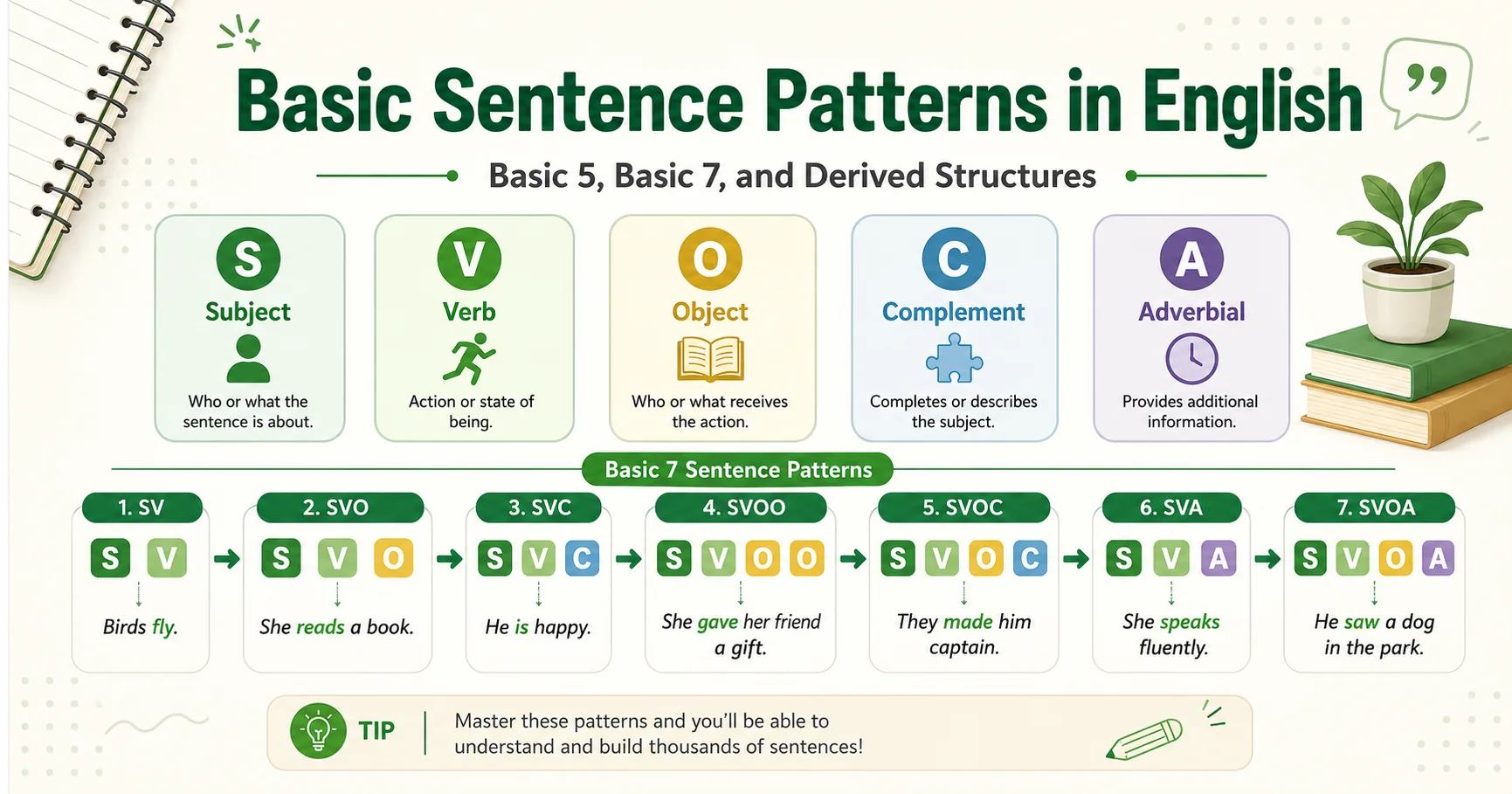
Learn the basic 5 and basic 7 English sentence patterns with examples, differences, derived structures, and practice exercises.